Stage is the residency programme initiated by 51N4E and hosted at TRACK. Through an annual open call, it supports short-term investigations that connect collaborators of the office with other internal and external practices, researchers and disciplines, opening architectural practice to dialogue, experimentation and critique.
Stage n.3, (a)wake for what grows, 2026
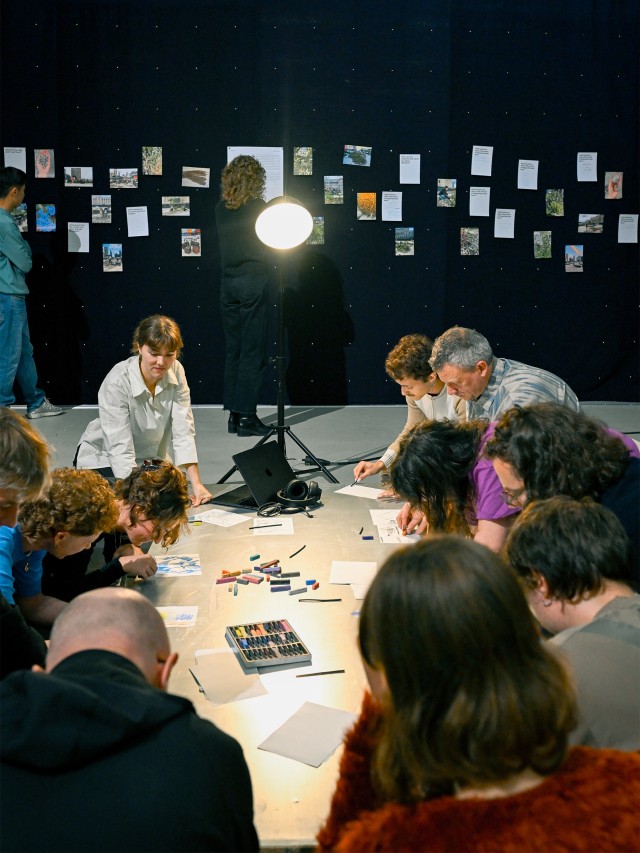
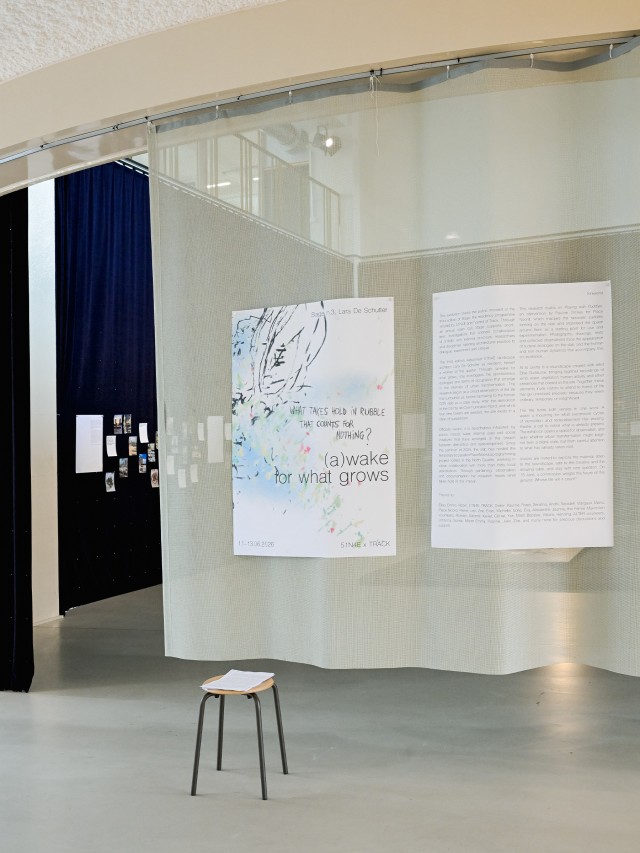
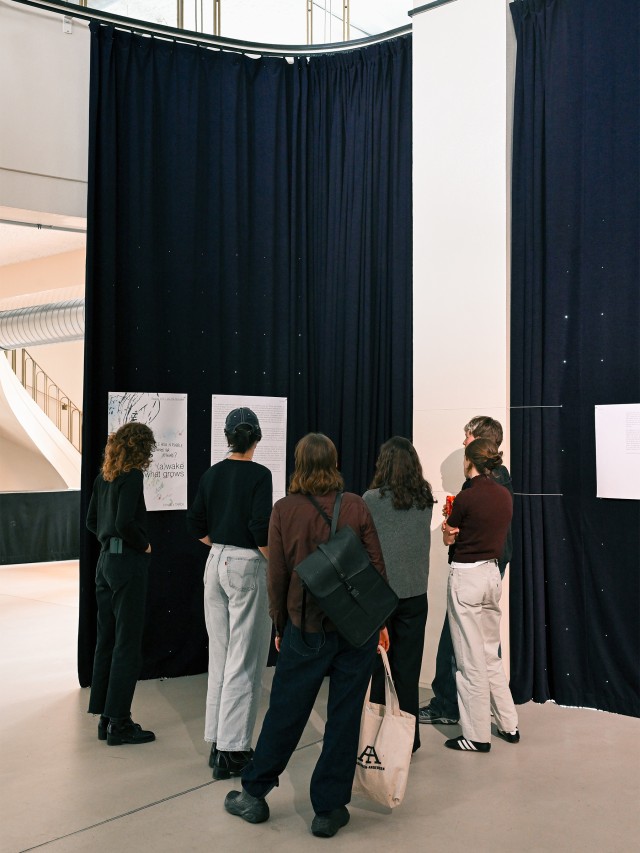
Its third edition welcomed 51N4E landscape architect Lara De Schutter as resident. Over several months, (a)wake for what grows explored the spontaneous ecologies and forms of occupation emerging on the former Centre de Communication Nord slab, right next to Brussels North Station, questioning how urban transformation might begin by paying attention to what is already there rather than starting from a blank slate.
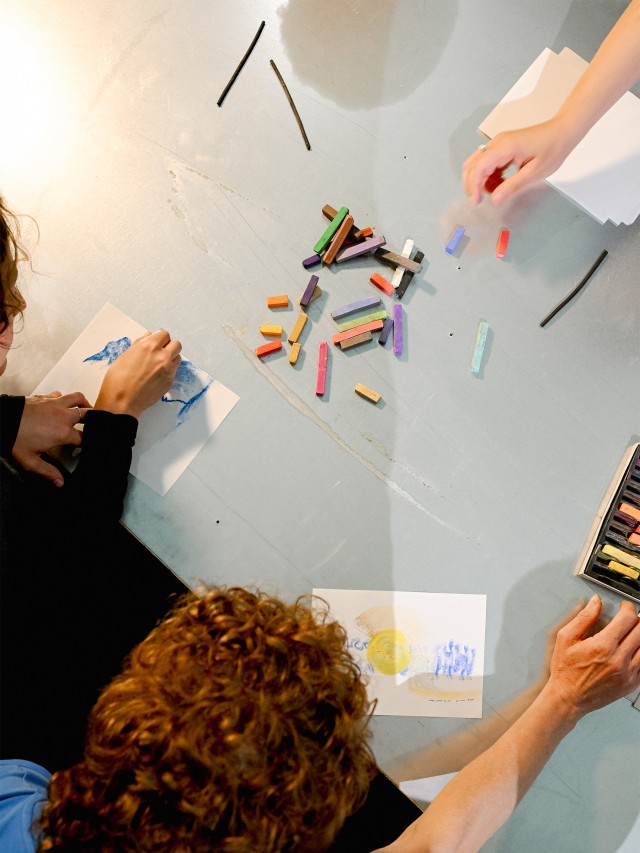
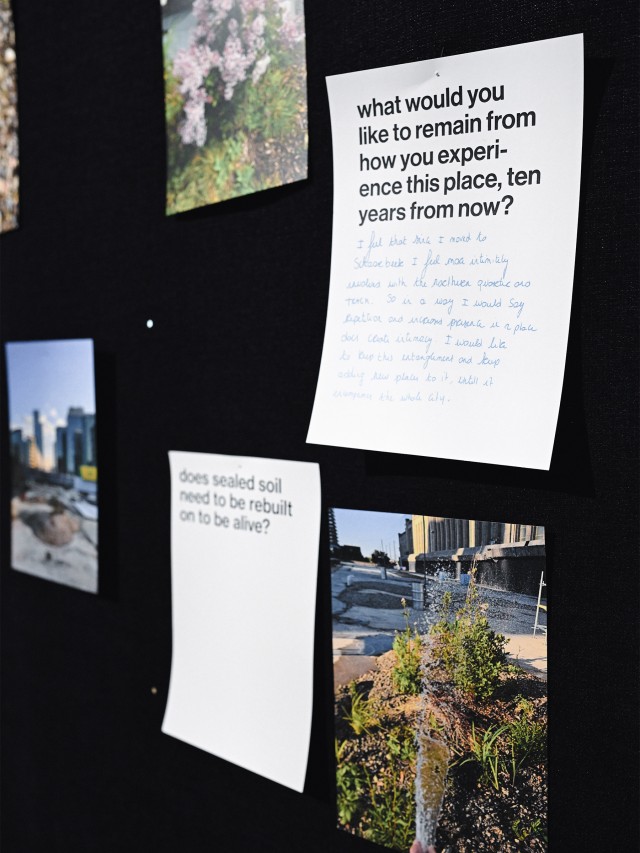
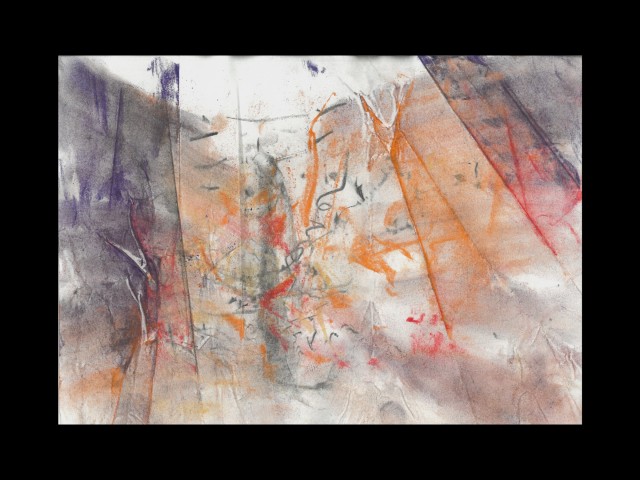
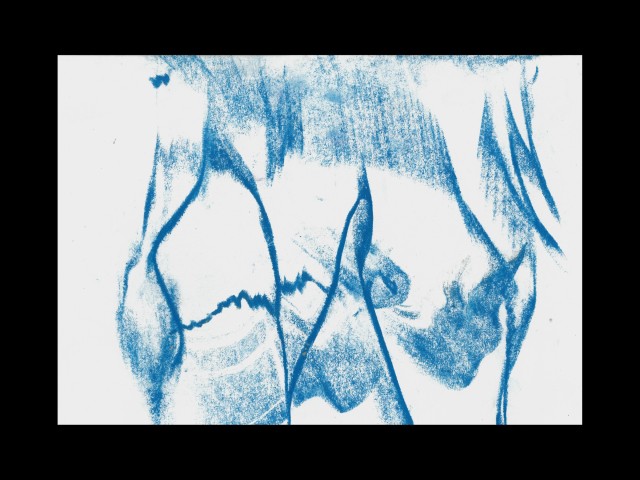
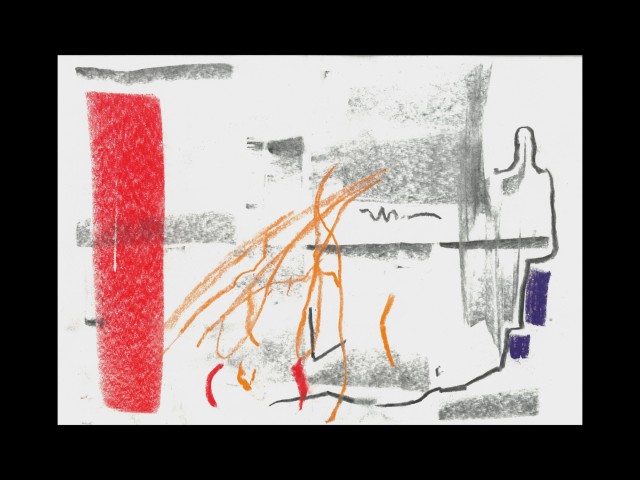
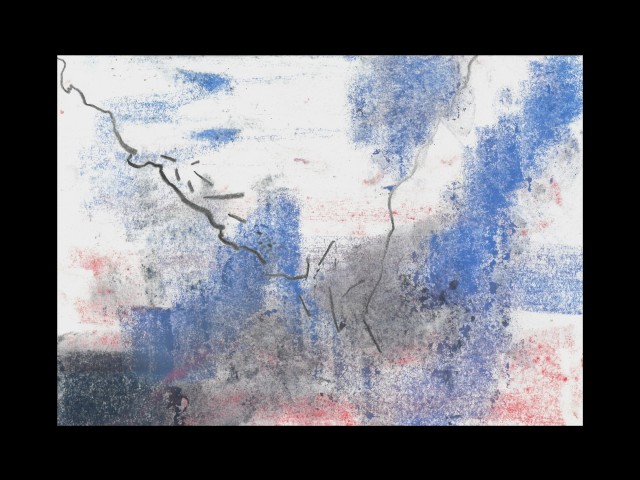
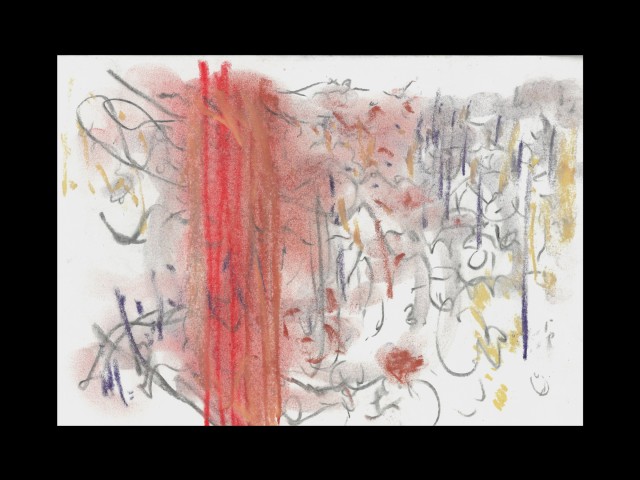
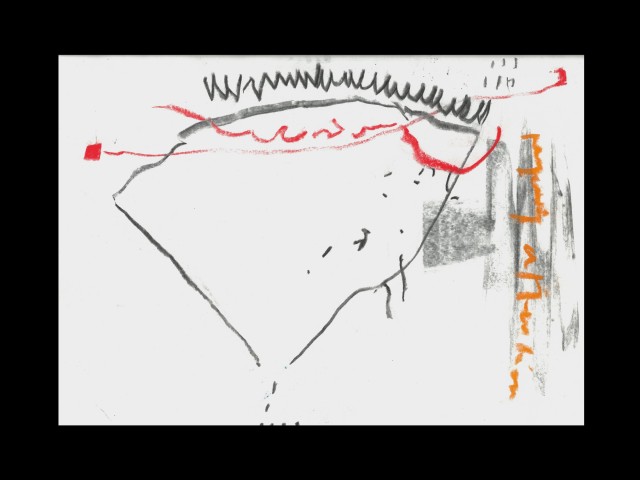
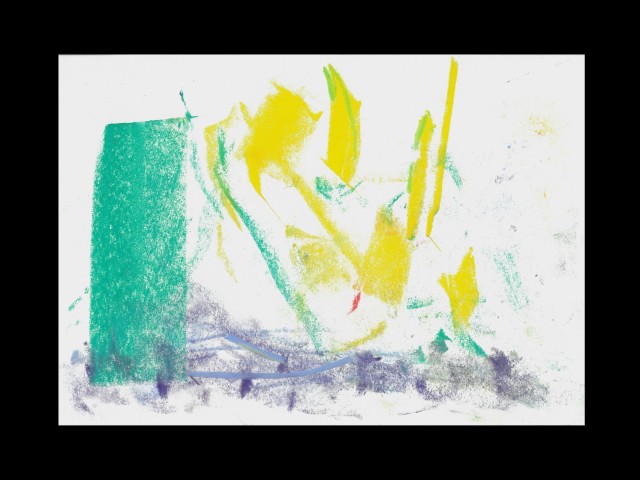
Presented to a public audience as an exhibition at TRACK in June 2026, the residency culminated in an installation bringing together drawings, observations, photography, collective gardening and a soundscape, inviting visitors to reconsider what counts as life in places awaiting redevelopment. The audience members were also invited to draw what they heard while listening to the live soundscape, tracing both living and non-living presences inhabiting the slab.
The following essay was written by Lara as the residency unfolded into its public moment. Expanding on the research presented in the exhibition, it reflects on the ecologies, values and forms of life that emerge in the intervals of urban transformation, and asks what it means to practise landscape architecture from within these conditions.
(a)wake for what grows
Since the 1960s, the North Quarter of Brussels has been subject to the same logic, repeatedly: land is cleared, left to wait, and built over, only to be cleared again. Buildings here are not cleared because they failed. They are cleared because the land beneath them can earn more as something else. Each cycle arrives with the same promise: that building will create value where there was none.
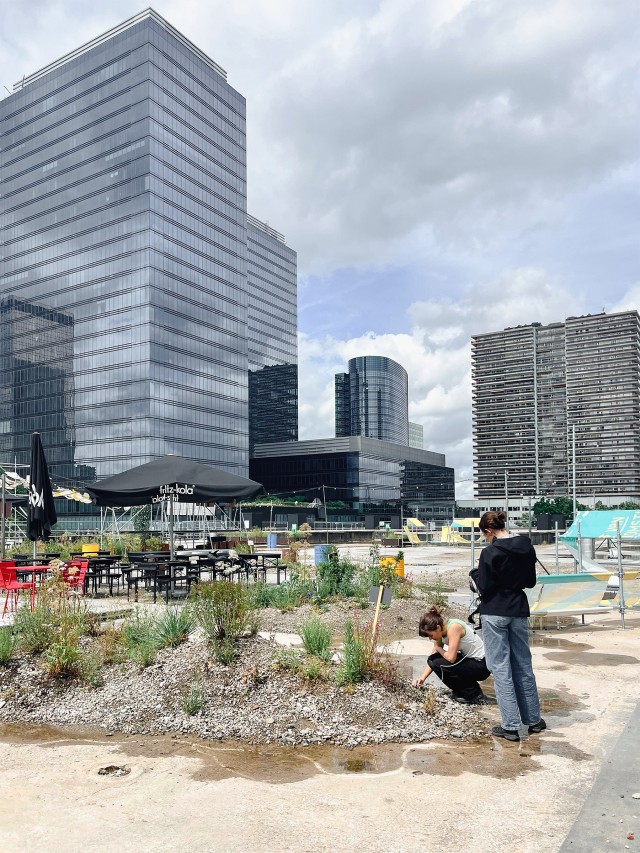
The first clearing set the pattern. A dense, living neighbourhood was expropriated and demolished by public decision for the Manhattan Plan, a project only partly realised, which left much of the quarter as wasteland for decades. The Centre de Communication Nord rose on that ground between 1974 and 1982: a transport interchange built to move people through, the metro, trams, buses and coaches of one of the busiest station nodes in the country, later capped with regional government offices. It was demolished in turn between 2023 and early 2025. What remains is a concrete slab, fenced while the permit for Project NOR, four new towers of 50 to 105 metres, two for housing and two for offices, moves through procedure. One cycle ends; another is already being decided. The public enquiry closed on June 2nd 2026. ARAU holds a press conference to present their counter project to Project NOR on June 13th. The concertation commission meets on Monday June 15th.
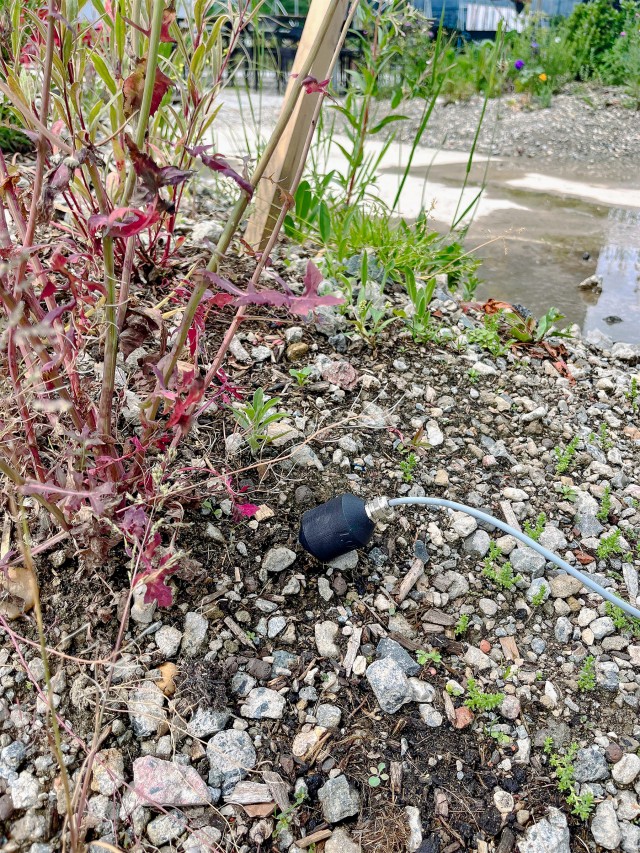
I came to this slab through the logic that produced it. I work as a landscape architect inside the processes that clear and rebuild urban ground. For six months I came to the other side of the fence, on and off, to water and to watch what the logic cannot see. The demolition and the fence do not mean the slab is empty. While the dust settled on the bare concrete, something was seeping in. In the cracks between slabs, along the joints, wherever a thin layer of debris had collected, ruderal plants were taking hold. Mosses spread in the depressions where rainwater gathered; birds came to the puddles to drink and cool down from the urban heat. From the logic that produced this site, none of this counts. The plants are not an asset, they generate no financial return, and the ground they occupy is officially vacant. But they are not nothing. They are a form of value the development model has no instrument to measure: life that organised itself without investment, in conditions that investment created by leaving. Does sealed soil need to be rebuilt to be alive?
Anna Tsing observes that progress draws other kinds of time into its rhythms, and that without that driving beat we might notice them. Ecologists call what gathers in these intervals disturbance-based ecologies: assemblages that thrive precisely where things have been broken or left behind. They do not form harmonious communities, but they make conditions for other life, insects, birds, soil organisms with nowhere else to go in this part of the city. Tsing is careful never to let this persistence become consolation. Life in the ruins does not redeem the ruining. It refuses to let ruin be the end of the story, and stops there. The plants raise a question the development logic never asks: not whether the ground is alive, but whose life counts, and to whom. The promise of the towers is that building will bring life back. Life is already here. It is rarely listened to.
None of this is new. Gilles Clément named the third landscape more than twenty years ago; Berlin made a nature park of its railway wasteland a quarter century ago; in Brussels, the friche Josaphat has been inventoried, defended and contested for over a decade. The spontaneous ecology of land awaiting development is a known object, with a literature and a militancy of its own. What is rarer is the view from inside the development practice. I did not come to this slab to discover that weeds have value. I came to test what someone in my position can do with that knowledge.
Why is the life that asks for the least the hardest to make room for? Real-estate appraisal has a name for the rule that condemns it: highest and best use. Land must be put to its most profitable purpose; anything less is underuse. By that doctrine, a slab where mosses drink rainwater and neighbours gather is not alive. It is underperforming. The question is never what the life here asks for, which is almost nothing, but what the ground could earn instead, which is everything. A modest life returns no margin, so every metre it holds reads as loss. And what asks for nothing has nothing to bargain with: in a city where room is negotiated, needs without demands go unheard.
My profession sits inside this rule. Landscape architecture is, in principle, the discipline charged with making room for living things in development. In practice, the room it secures is mostly bought: vegetation as image, as service, as a value the towers can charge for. I am trained to defend this life by translating it into figures, cooling, retention, biodiversity, attractiveness, and the translation sometimes works. But what is admitted for its return remains subject to the same test, and will be dismissed the day something earns more. Valuation secures nothing; it rents. The question I keep turning over: can the value of this life be translated into the language that decides its fate, without becoming the force that clears who I claim to build for?
The plants and the people of this neighbourhood share a condition. Both are reorganising in the gaps. What persists there, the organisations, the informal networks, the ways people have learned to make life here, does not appear on a developer’s balance sheet. Yet it is the neighbourhood.
The occupation gathered on the slab under the name Place Noord found its crack the same way the plants did. People from the quarter saw the slab lying empty between demolition and reconstruction, and wanted to make a place where the neighbourhood could meet and where its associations could be seen. The permits foresee a public activation of the slab, but only once the works are complete; in the interval, nothing obliged the fence to open. Access was negotiated, and it took the only form the conditions made viable: a commercial operation, which also carries and funds the non-commercial programme alongside it. Without that economic model, the slab would not have opened at all. Place Noord, a programming project rooted in the North Quarter and working with more than thirty local associations, exists inside that arrangement. This is not a failure of anyone working inside it. It is the shape access could take. If anything, the goodwill inside the constraint exceeds what the constraint requires: the operator carried not only the events, but part of the care this research describes, financing a presence on the slab it was never obliged to fund. Generosity exists at every level of this story. What is missing is not goodwill. It is an instrument that does not depend on it.
That arrangement sets the limits, for everyone working inside it. The slab is accessible when the bar is open, on the terms of the activity that funds it: an operator must programme what sustains the project, and what sustains it is not always what the quieter lives around the station need most. That is not a choice made on the slab; it comes with the arrangement. Like the plants, the life gathered here is let in without being secured. The crack admits it, and the crack can close.
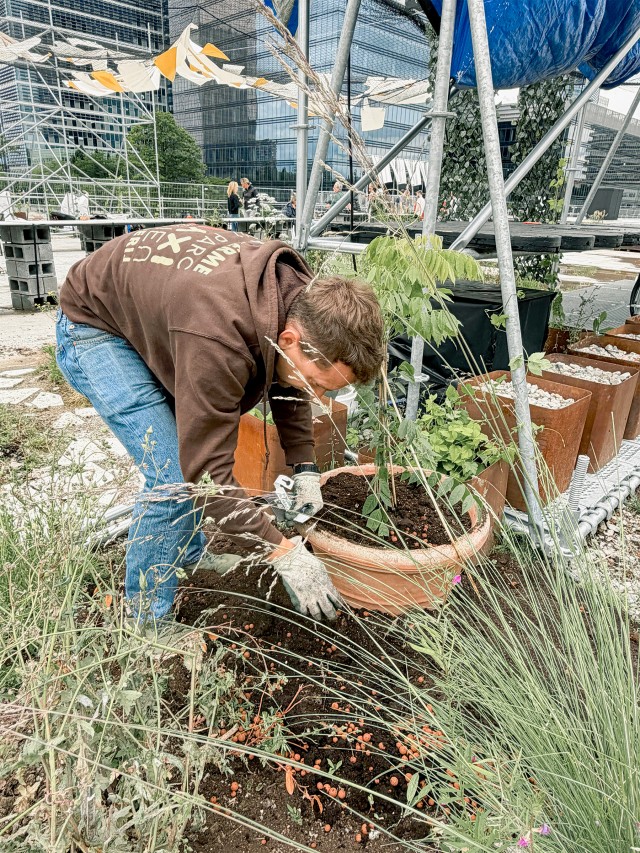
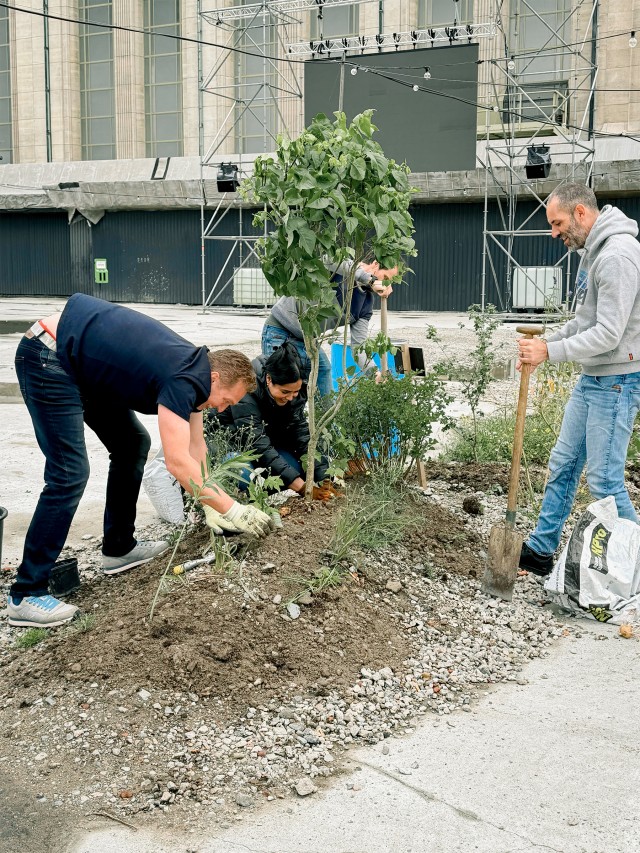
The mounds work by the same principle, and point toward a different one. Building on Playing with Puddles, an intervention by Pauline Omnes for Place Noord that mapped the puddles forming on the slab and organised the space around them, mounds of crushed demolition rubble from the recycling company Vanpachtenbeke were brought in to cover the water and to carve out small protected pockets for vegetation, away from the foot traffic of the events. The water retained beneath the rubble stays cool and feeds the plants above it. The intervention was realised in a short time and as a collective effort, together with the collective ALTER and volunteers, during the summer of 2025, before the official opening of Place Noord. Together we found dying plants, burning in the sun, left from Ferme Maximilien’s temporary activation of Simon Bolivar square during the demolition period. We salvaged them and planted them in the mounds with little hope for their survival. To everyone’s surprise, all but one survive to this day. Their provenance came to light when the farm arrived on the slab in December 2025, the beginning of its involvement in the vegetalisation of the mounds. Ferme Maximilien has held ground in this neighbourhood since 1987, through every development cycle, using whatever breaches it can find to boost biodiversity; it currently works omongst other projects, within the frame of the contrat de quartier Héliport. After several rounds of planting whatever we could find, by spring the vegetation had taken hold. The mounds did receive investment in this interval, of a kind the model doesn’t book: water, time, attention. They asked for little else, and far more grew than expected.
If the argument of this project is that life is already here, the problem is that it is not perceptible to the processes that decide its fate. With artist Elise Guillaume, whose practice sits at the intersection of ecology, psychology and sonic attention, we collaborated on a soundscape of the slab: wind, water, plants, the activity of the organisations, the non-human presence that development does not record as worth keeping.
The CCN was a communication node in the older, transport sense of the word: a conduit for human passage, a place you moved through on your way elsewhere. The soundscape does the opposite. It holds still and listens to what stays in place. Instead of moving people through, the slab receives and holds what is already there. During the opening it is broadcast live, so that the quieter things coexisting on the slab can briefly be amplified, and attention can, for once, be held on them.
What is not yet decided is whether the next cycle will make space for what is already here, or erase it. The mounds are a small argument for the first: that the new project should carve out space, deliberately, for the biodiversity and the social tissue that have established themselves in this interval. Not as ornamentation, and not as a green feature to offset the towers. As a condition of the permit, binding and secured, rather than a negotiation after the fact. A binding condition does not ask this life to prove its profitability; it simply holds ground open for it. Tolerance and goodwill, however real, can be withdrawn at any moment, and once construction starts, only what is written into the permit still counts. Permits are not written by developers; they are granted, and conditioned, by public authorities. The instrument is not hypothetical: the current permits already foresee a public activation of the slab once the works are complete. Conditions of this kind can be written; the question is what they hold space for, and when. Whether the next ones make room for the life that has already taken hold is a political choice, and it is being made now. The neighbourhood has been finding its own cracks for sixty years.
This is a wake in both senses. A vigil for what these cycles erase, the neighbourhoods, the communities, the life that does not count, and an act of waking to what persists regardless. Mourning and life are one motion. The hope it holds does not dissolve the grief, and does not absolve the cause. It insists, quietly, that it does not have to happen this way.
Credits Stage n.3
Resident: Lara De Schutter
Curators: Emma Bourguignon, Robin Vandenbussche
Supported by: 51N4E, TRACK, PLACE NOORD
Soundscape: Elise Guillaume
Mixing: Luis Trinques
Featuring work of: Pauline Omnes
Photography: Sepideh Farvardin, 51N4E