Learning from Peterbos 9
Interview by Emma Bourguignon, pictures by Sepideh Farvardin
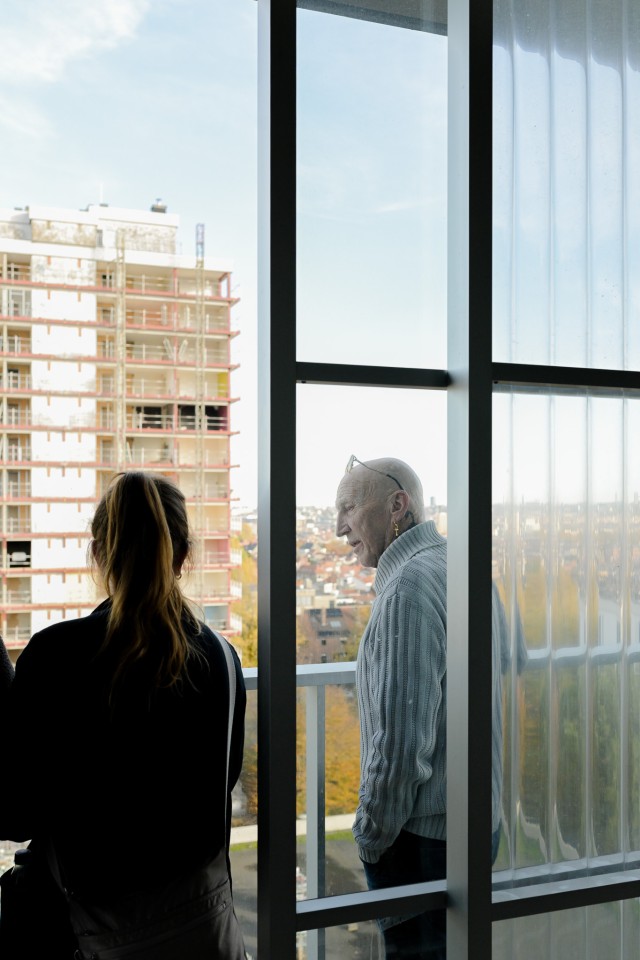
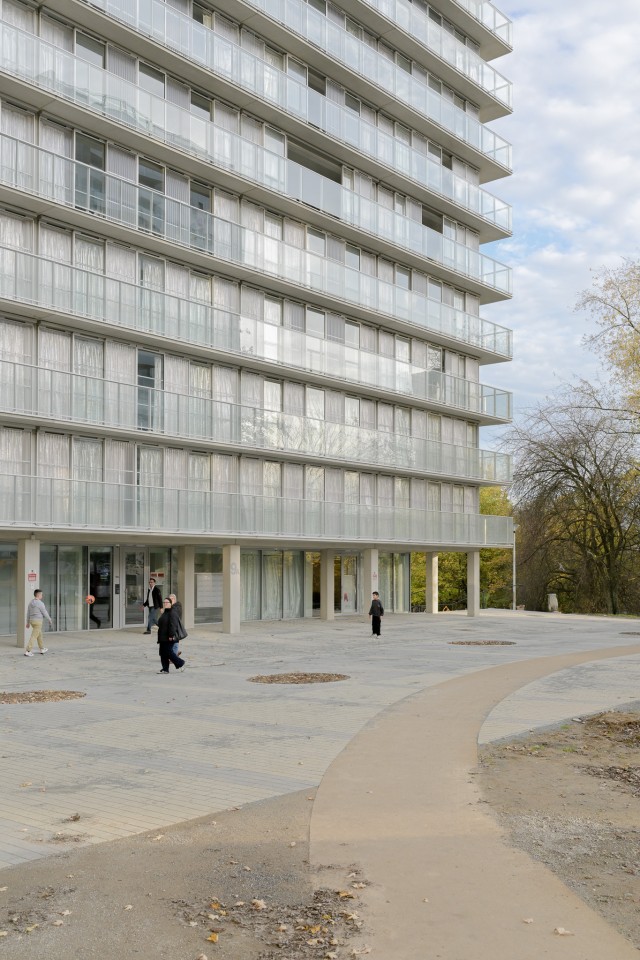
In the context of the Festival of the New European Bauhaus taking place from 9 to 13 June 2026, Building 9 of Peterbos Park, a large social housing complex in Anderlecht, will be open to visits. The project, led by 51N4E in collaboration with Lacaton & Vassal, renovates 80 dwellings while keeping residents in place throughout the construction process.
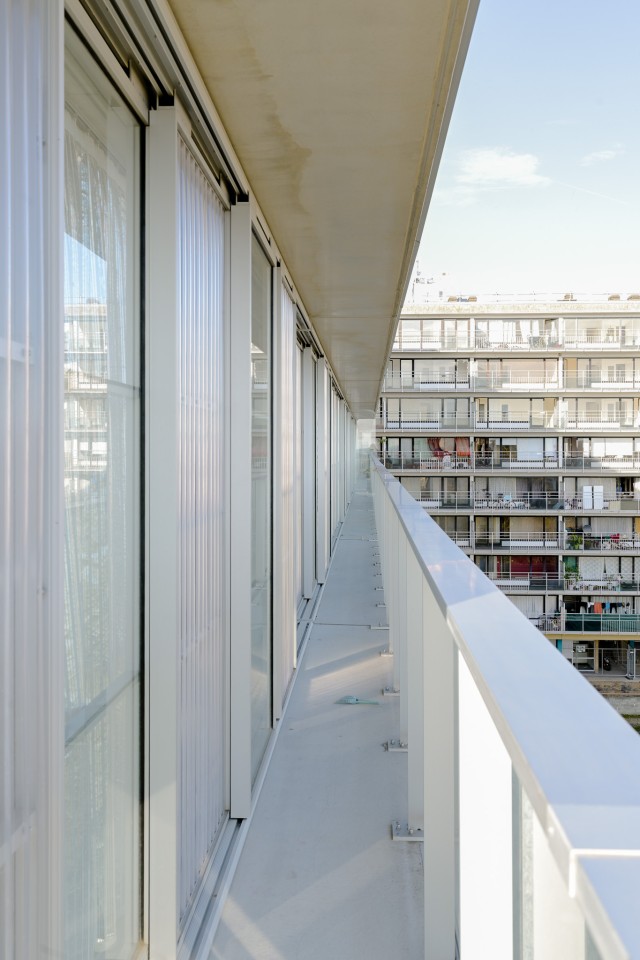
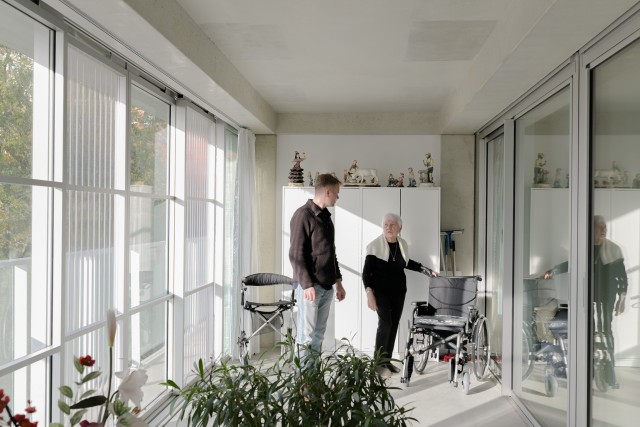
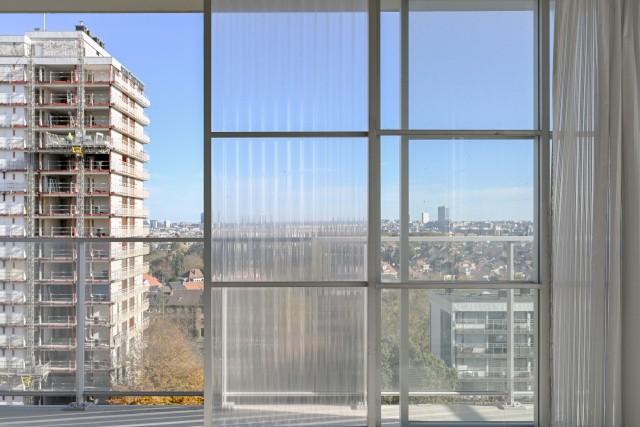
The spatial transformation offers a total of 54 m² of extra private space: winter gardens, balconies, and new living space added onto the existing façade. Due to building logistics using prefabricated concrete elements, the construction could take place while the apartments were still occupied, following a strong concept developed by Lacaton & Vassal since 2011. No one was forced to move out during or after the renovation process and rents were not directly impacted by the works.
In this first collaboration within the Belgian context, the Peterbos 9 project raises a broader question: can construction works in an inhabited building become a globally reproducible architectural methodology?
A conversation between two colleagues, Emma Bourguignon and Ruben Janssens (51N4E), project lead of Peterbos 9, discussing from within what drives our work here at 51N4E while also celebrating the exceptional character of the project. Together, we reflect on the conditions that made the project possible: from convincing the client to organising the construction site, building relationships, and testing the limits of this sustainable approach in Brussels.
EB: Thank you for taking the time to reflect on the project, a year and a half after its delivery. I would like to start by introducing the idea of construction works on an occupied site early on in the process. Adding the winter gardens brought a huge improvement in quality to the housing. Did you have to convince the inhabitants that the works would be possible while they were still living there? Or how did it start?
RJ: I think the first step was convincing the client. We had the luxury of being able to take the client to Bordeaux, where we visited Lacaton & Vassal’s project in Cité du Grand Parc together. We talked to inhabitants there, which is exactly why we later introduced communication moments with the residents into our process for Peterbos 9.
Their project in Bordeaux is a successful renovation based on the same principle as what we did for Peterbos 9, adding onto the existing façade. I remember us visiting two apartments in Grand Parc, which was like showing a 1:1 model of what we wanted to do in Brussels. Afterwards, the clients were like, “Yes, it’s fantastic, we should just do it”.
Thinking of this project as a copy would be a misconception, all aspects of the concept had to be redesigned for the Belgian context. Technically, we had to rethink everything specifically for our context and climate: the execution of the concrete, the assembly, the framework… All the technical aspects of the renovation were project-specific. The challenge was bringing it into our market and building culture, with local energy regulations, material use, and proving that technically, we could also do it here, with the advantage of already being able to demonstrate that the concept was successful.
EB: That was my next question. You’re talking about the advantages of carrying out the works while the building remains occupied. Can you explain what this brings, not only architecturally but socially as well?
RJ: If you look at this renovation in a classical way, you would need two years to empty the building before you can start the works. There’s also the human impact of having to relocate somebody who has lived somewhere for almost 50 years, for instance. It’s unimaginable.
That’s why we saw this approach as something worth introducing.
The added cost of coordination between the construction schedule and the inhabitants during the works is factually lower than the operational cost of moving people out, maintaining an empty deteriorating building, and then bringing people back. Rehousing the same people would not even be possible because of social housing regulations in Belgium; it’s complicated and costs time and money.
EB: The construction works taking place in a building occupied by its current residents, is a way to go around these regulations and the risk of people losing their dwelling.
RJ: Exactly. And I do have the feeling that the whole project strengthened the collective feeling within the group. Everybody recognises each other much more now, I think it comes from a shared struggle.
EB: As in, it’s a struggle to go through these years of construction?
RJ: Yes, of course, there’s not a single person who would say this construction site just went by like a breeze. But because the process is much more complex, you learn to find more sensitive solutions. That also means intervening less, which is particularly interesting.
EB: How did that all come together? Was it the idea to do it already from the competition?
RJ: Our idea, yes, but not the client’s. The client had in mind to have people rehoused elsewhere on site while renovating this building. At 51N4E, we’re exploring different ways of approaching patrimony from the 60s, 70s and 80s, while testing and experimenting with methodologies for large-scale renovation and systematic solutions. We’ve been working on ways to apply these solutions in a sustainable way, through our collaborative platform called RECAST. From there came the idea to test this methodology through a call for a building in Brussels that perfectly suited this type of renovation, namely Peterbos 9. On top of that, we discovered that the structure of the building didn’t allow for a shift in typologies. So, we kept the plan exactly as it was.
To apply the winter garden model, you need a specific situation: a building whose structure still has value but is too fragile for major intervention. In Peterbos 9, this meant keeping the existing typology and searching for added spatial quality outside the original volume, within a limited investment budget.
The winter garden becomes interesting because it creates protected, usable, private space without becoming fully heated interior space. In social housing, this is especially valuable because the added surface does not count as rentable area while still significantly improving living quality.
EB: How did you organise the construction site with people living there?
RJ: We maintained a close collaboration between both offices and the contractor. One person was specifically dedicated to day-to-day coordination, together with the technical coordinators, planning interventions, managing communication with inhabitants, and making sure the process remained workable for all parties.
On this scale, we wanted to apply a clear division of responsibilities, something we had already requested in the brief.
EB: Would you say that the design was influenced by the operations planning and technical organisation?
RJ: Yes, of course. We were reiterating all the works based on the construction planning, already during the design phase. For example, we came up with a method to change all the vertical techniques in a more efficient way, which was less intrusive for the inhabitants.
You don’t only think about the intervention and the result, but also: how long will it take? Is it possible while people are living there? You almost imagine yourself living there and how you would feel about the works on the façade.
In that sense, involving them in the process, and sharing the result of the project with the people that live there is necessary for the group of inhabitants to really understand what’s happening.
It started with information sessions during the building permit phase, which turned into feedback sessions, to update people on the planning of the construction, rather than just putting posters up and saying, “hey, next week this is happening”. One apartment was used as a site manager’s office, so people could just come and ask questions.
EB: So, you had this personal, almost consulting contact with the inhabitants because of these relationships that were created. Did you involve them during the construction phase itself?
RJ: We created moments to invite inhabitants on the structure, or to show them the curtains prototype, to explain what was happening and what it would become, and those were the first moments where people actually understood. Before delivery, we visited all the apartments, talking to all the inhabitants, showing them how to use their new winter garden. And when the works were finished, there was an end-of-the-construction-process party.
EB: Nice. Are you surprised by the way that people use their winter garden today? Did you see some ways of using it that you were like, yeah, I wouldn’t have thought of this.
RJ: There’s no fixed equipment in the winter garden, which is something residents don’t really understand. They suddenly gain all that space, and at first, they think of it as a large terrace.
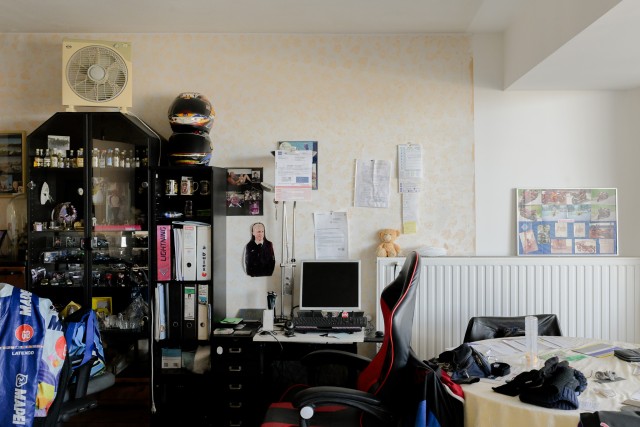
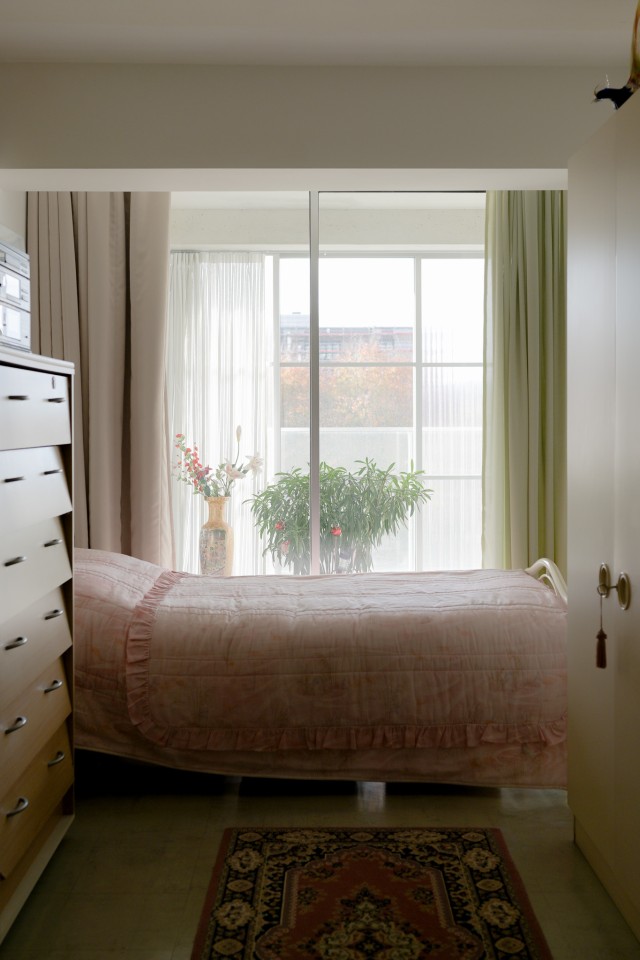
But for example, we visited a man for whom it was very important to look decent. And he said, “Before, I always had to squeeze my ironing board somewhere between the washing machine and the dryer, now I just put it here and it can stay forever”. And he was super happy with it. So, the part of his winter garden in front of his kitchen has become like a big laundry room. Quite a few people have turned it into a paradise for their cats, or a play area for families with smaller children. An elderly couple who can no longer move around as easily said, “last summer was one of the best summers ever because we now have this giant sun terrace and we’re in the comfort of our own home”. It gives a lot more breathing space.
EB: One of the core threads running through the whole process, with the tight coordination, seemed to have been the relationships that were built and maintained, with the users, the contractor, the whole project team and the client.
RJ: Absolutely. It may not seem essential from a purely architectural standpoint, but these relationships are crucial for legitimacy, trust and future collaborations. I believe this is essential. It is about finding the right balance between structure and flexibility. I think that good architecture should allow for collaboration while still guiding execution decisions. If it starts already from the conception phase, and everyone is involved until the end, you immediately set the temperature right. There’s indeed tight coordination necessary to maintain a good relationship during the works, and if you can make sure that everybody is on the same page and understands what they are doing and why, it creates a much bigger team feeling during the building process.
EB: Is it something you think 51N4E could reproduce in another project?
RJ: The methodology is reproducible, but only under specific conditions. If they are met, then there’s not a single reason for not pursuing this option of keeping residents in the building during the construction works.
The building must remain structurally sound enough to renovate mostly from the outside, and the existing typology has to stay the same, which means that what you do inside the building is extremely limited.
Once those conditions are accepted, the process depends on extremely rigorous planning, coordination, and a clear explanation of the methodology to the contractor. Each evening everything has to be usable for the inhabitants, so it needs to be clear exactly how many days of work are required for each toilet and bathroom.
And maybe taking strategic decisions early on in the project, that will just steer it in a good way from the very beginning. Proper preparation, I think, is one of the important lessons we learned from the methodology.
EB: When talking about an architectural methodology, it’s interesting to make the distinction between the technical side and the social side of it. It’s not a question, more of a reflection. (Laughing) I hope through the visits, for example, for the Festival of the New European Bauhaus, that people can understand that distinction, and the way that the two trajectories meet up. What made it successful in the case of Peterbos 9?
RJ: Continuity. Almost the same people remained involved throughout the process. That builds trust within the team and with the inhabitants, because we get to know each other over time. I think the value of personal investment and building these qualitative relationships in a project should almost be valued as highly as architectural quality.
And also our role in our collaboration with Lacaton & Vassal, our interpretation of the sustainability in their model was maybe our added value in it – allowing Lacaton & Vassal’s soberness and 51N4E’s generosity to clash with each other.
EB: Did 51N4E in that case, get as inspired by Lacaton & Vassal’s method, as we have been by our other projects?
RJ: Architecturally and socially, it’s very much inspired by Lacaton & Vassal. That kind of renovation is socially oriented, so I feel like the technical expression that Lacaton & Vassal gives it is informed by pragmatism and cost in relation to social (and architectural) impact. That is something we adopted in this project, but had to technically rethink because of our building context. So this methodology, while being pragmatic and minimal, has to respond in its basic form to all our regulations.
EB: In a visit you did with Andreas Ruby last year, he visited the project and called it ‘the most generous project of 51N4E’, referring to the way we allowed Lacaton & Vassal to remain faithful to their method, without exploring themes such as additional non-domestic uses, landscaping or community activities, topics that are characteristic of our work, in his own words. He questions the visibility of our contribution to the project, which, for him, is essential in allowing a ‘manifesto-like project to take root in the messy reality of a place like Peterbos’.
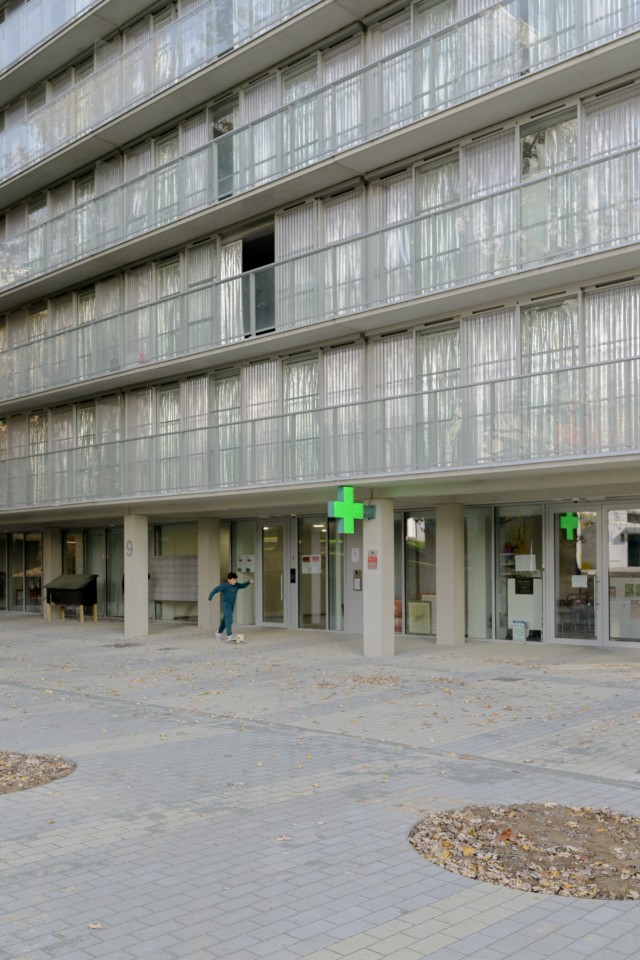
While I feel that through our conversation we can give a better understanding of the invisible work that 51N4E brought to the collaboration, I find interesting that Andreas points out the fact that the pharmacy remained inside the building, which he says is an improvement compared to Lacaton & Vassal’s other projects, which generally lack any public program.
RJ: Indeed, the ground floor of our building has an important role in reactivating and providing space for collective functions in the neighbourhood. With the very limited margin we had within the structure of the building, we were able to reorganise the plinth into four volumes, each with its own entrance and functioning as an independent space. Originally, there were also apartments on the ground floor, which we upgraded into individual social and commercial units. Before the works, the building already hosted a neighbourhood pharmacy and a small grocery store, and we fought hard to keep the pharmacy in place because it plays such an important role in the neighbourhood.
As facilities and social support in the neighbourhood continue to grow over the coming years, these functions can hopefully move into the spaces foreseen for them in the plinth of Building 9. Today, the double-height space on the south façade is occupied by Foyer Anderlechtois, while SAAMO Brussels is located next to the pharmacy. In my opinion, SAAMO is the ideal occupant for this space because of its important social role on site. Their presence in the building already represents a significant added value: they run a very active programme, organising meetings and workshops with the inhabitants of Peterbos.
EB: Ruben, thank you so much for this conversation.
RJ: Thank you.
Tours of Peterbos 9 will be organised with Ruben Janssens in the context of the upcoming Festival of the New European Bauhaus, on 10 and 11 June 2026. Register here.